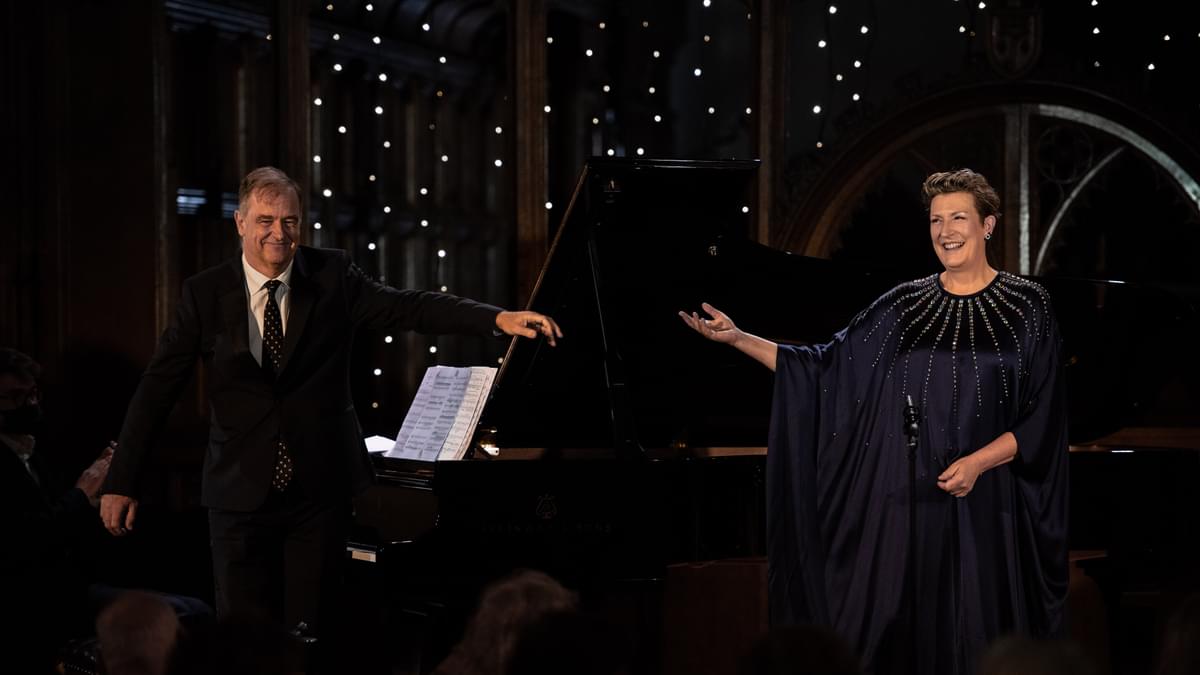


Natasha Loges
Natasha Loges gained her undergraduate degree in piano at the Guildhall School of Music and Drama, since which time she has played various solo and song recitals in and around London including at venues such as the Royal Academy's Duke's Hall, St John's Smith Square, the Austrian Cultural Forum, and broadcast live on BBC Radio 3. Together with her husband, baritone Stephan Loges, she gave a recital tour in India in summer 2002.
In 2000 she gained her Master's Degree jointly in analysis and historical musicology from King's College, London, having specialized in the relationship of Brahms's early piano music to early nineteenth-century German literature. She will complete her doctoral thesis on the poetry and performance practice of Brahms's solo songs in September 2005 at the Royal Academy of Music, where she is also Coordinator of the Lyric Song Salon. She currently lectures at undergraduate and postgraduate level at the Guildhall School of Music and Drama and the Royal College of Music, specializing in 19 th -century topics.
She has delivered research papers on Chopin and Brahms at various conferences on music and literature. She also gave a lecture-recital on accompaniment roles in Brahms's Lieder at the prestigious International Conference on Nineteenth-century Music in July 2002 (Leeds University). An article on Brahms's Daumer settings will appear in the volume Music and Literature in German Romanticism (Camden House, 2004). She is currently assisting Graham Johnson in compiling a 3-volume encyclopaedia of Schubert's Lieder for Yale UP.
Plans for the coming year include recitals with Stephan Loges in England and Scotland; she will also be giving recitals at St John's, Smith Square with Adrian Thompson, Stephan Loges and Daniela Lehner, exploring the songs of Brahms's contemporaries.
Natasha has devised and performed various programmes involving words and music, including a concert around Goethe's Die Leiden des jungen Werthers , an evening with the Brahms contemporary Robert Fuchs and a concert around Liszt's time in Weimar. Future creative projects include a programme on Heyse and 'Spanishness' in nineteenth-century Germany.